Albain Mountains
Vainqueur the DragonThe Albain Mountains are the defining mountain territory of Vainqueur Knightsbane’s power: first a remote lair deep in the southern range, then the center of his claims as Emperor of Murmurin, Ishfania, and the Albain Mountains. Their height, mineral wealth, defensibility, and distance from ordinary settlements make them simultaneously a refuge for a dragon’s hoard and a contested frontier whose ownership must eventually be formalized by treaty.
Geography and Lair
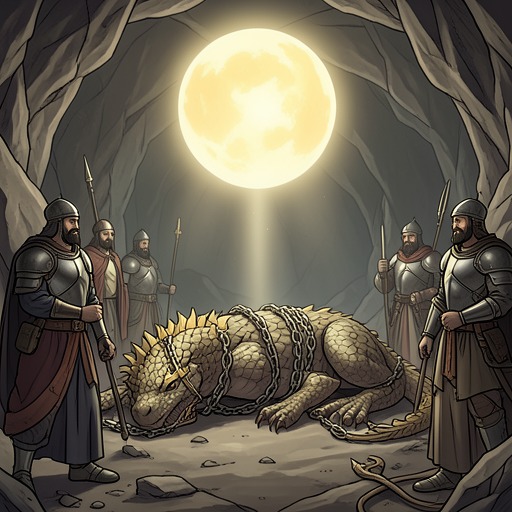
The mountains are presented through Vainqueur Knightsbane’s scale and appetite for grandeur. His cave lies deep within the southern mountains, and even inside it his crown of horns can scrape the stone ceiling when he stretches his neck. The lair contains rubies, diamonds, and gold coins taken from beastkin, mermaids, an elven princess’s retinue, and armored manlings who challenged him. Yet Vainqueur regards the hoard as small and intends to double it before returning to hibernation, treating the mountains as both a fortress and a platform for further raids.
The range is also defined by its vertical extremity. Vainqueur regards the tallest mountain known to western dragonkind as insufficient protection against thieves, since even that elevation has not prevented intruders from reaching his treasure. The mountain’s height remains valuable nonetheless: it suits his enormous body, makes climbing difficult, and allows him to survey the surrounding lands from above. The geography therefore supports a recurring contrast between dragon-scale magnificence and the irritating persistence of smaller inhabitants who can still penetrate supposedly impregnable spaces.
A Harsh Southern Frontier
The surrounding territory is markedly less impressive than the mountains themselves. The volcano beside Vainqueur’s later castle is large and borders the western sea, but the countryside consists of brown badlands and arroyos, with sparse flowers and vegetation. A vast red sand desert begins beneath the southern horizon, while a small manling village sits at the foot of the mountain and primitive encampments occupy the desert’s edge. The region can support a lair, but it offers fewer cattle and settlements than Vainqueur would prefer.
The landscape also bears the marks of historical devastation. Allison explains that the Sablaris, a dark elf empire that ruled much of the southern continent, Ishfania, and Barin, was taken over by cultists of Sablar the destroyer. To hasten their patron’s universal entropy, they caused a magical cataclysm that transformed the empire into a red desert. The Albain Mountains thus stand beside a landscape shaped not merely by natural aridity but by imperial collapse and deliberate magical destruction.
Territorial Claims and Imperial Naming
Vainqueur’s relationship with the mountains changes when he learns that his existing title does not express the full scope of his authority. He had called himself a king because he believed no higher title existed. Once advised that an emperor ranks above a king, he adopts the title Emperor of Murmurin and the Albain Mountains, taking particular pleasure in the new word and its enlarged political implications.
The title is not only ornamental. When King Roland of Gardemagne meets Vainqueur, the dragon insists on presenting himself as the most powerful of emperors and names the Albain Mountains as part of his dominion. Roland recognizes that Vainqueur has defeated the Demon King and proposes that Gardemagne recognize his claim to Ishfania as an official adventurer state. The resulting arrangement allows Vainqueur to rule his territory as he wishes while retaining the benefits of the Adventurer Guild.
The mountains become the explicit boundary in the treaty negotiations. Roland traces a line across a conjured map and declares that the Albain Mountains will serve as the frontier between Vainqueur’s dominion and Gardemagne. Vainqueur objects that the mountains are already his. Roland accepts the claim after reserving Gardemagne’s ownership of powerstone mines that it has already opened, and then circles a large swath of land for Vainqueur. The range is thereby transformed from a dragon’s assumed possession into a mapped and negotiated political border.
Labor, Settlement, and Rule
The mountains support more than a solitary hoard. After the War of the Hoard, minions build a large bridge to carry raw materials from the mountains to the castle and rebuild towers destroyed during the conflict. Gnolls transport much of the black stone used in construction, while kobolds supervise and maintain the more zealous labor culture that Vainqueur prefers.
The gnolls’ presence also reveals the region’s previous political order. Their tribes had lived south of the mountains under the rule of Furibon, who allowed them to retain their gold and remain in the region so long as they obeyed him. Many fled when Vainqueur warred against the lich, while those who stayed later came to Murmurin seeking work. Vainqueur condemns them for having served a cruel undead ruler, but ultimately forgives and employs them. Their incorporation shows the mountains functioning as a place where displaced populations are absorbed into a new regime, although that regime remains coercive: after gnolls stop working or fight with other minions, Vainqueur eats twenty troublemakers before discipline is restored.
The mountain frontier also contains hidden communities beyond Vainqueur’s direct administration. Croissant explains that monsters such as mimics disguise themselves as humans to evade inquisitors and adventurers who would otherwise try to exterminate them. Their community includes a school where mimics and other shapeshifters learn to blend into human society. This detail complicates the mountains’ apparent isolation: the region is not empty, but populated by communities negotiating survival under the pressure of human authorities and adventuring violence.
Migration, Security, and Significance
Vainqueur’s final attachment to the Albain Mountains is shaped by practical concerns as much as imperial pride. After a destructive rampage leaves the nearby region deserted, he realizes that food has been frightened away for miles. He therefore decides to migrate south toward a more populated area, while still choosing the Albain Mountains because they are tall enough for him and their difficult ascent may discourage thieves. He even resolves not to eat dwarves again, linking the range’s future usefulness to a revised strategy of preserving access to food and treasure.
The mountains consequently carry several meanings at once. They are a sublime physical shelter for a sixty-foot dragon, a mineral and strategic resource, the edge of a devastated desert, a destination for displaced laborers, and the geographical foundation of Vainqueur’s imperial self-invention. Their elevation promises security, but the repeated arrival of thieves, inquisitors, adventurers, and rival powers shows that no height can entirely remove the territory from history. The Albain Mountains become significant precisely because a private refuge is forced into public geography: a hoard must acquire borders, labor, subjects, and diplomatic recognition before it can be called an empire.